

- Run fails
- Deployment fails
- Deployment succeeds
- A new error group appears, regresses, or is unignored
If you want to be told about every run that fails, choose a run fails alert. An Error group
alert will not do this — it deliberately stays quiet once it has alerted on a given error.
How to setup alerts
1
Create a new alert
Click on “Alerts” in the left hand side menu, then click on “New alert” to open the new alert modal.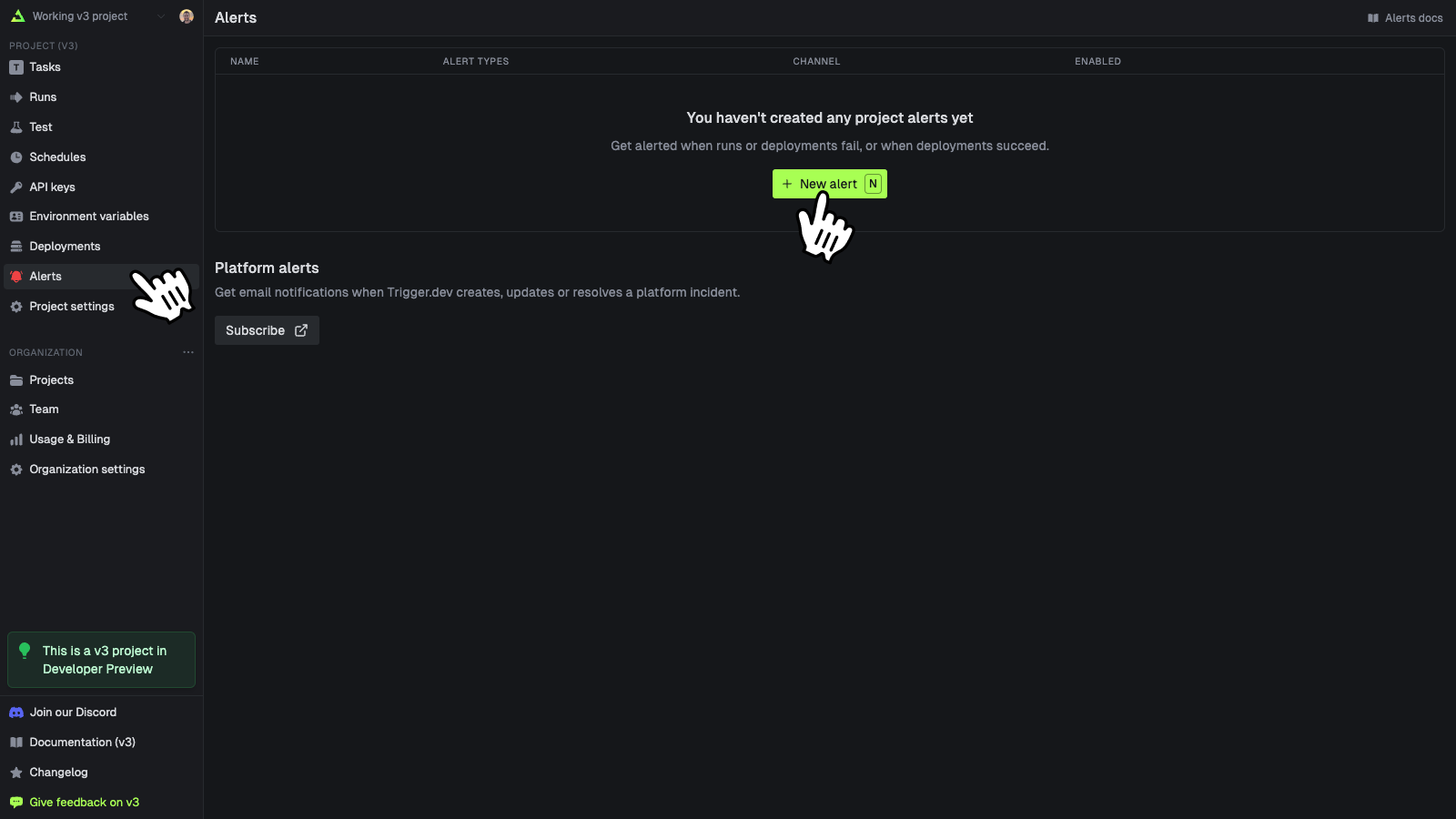
2
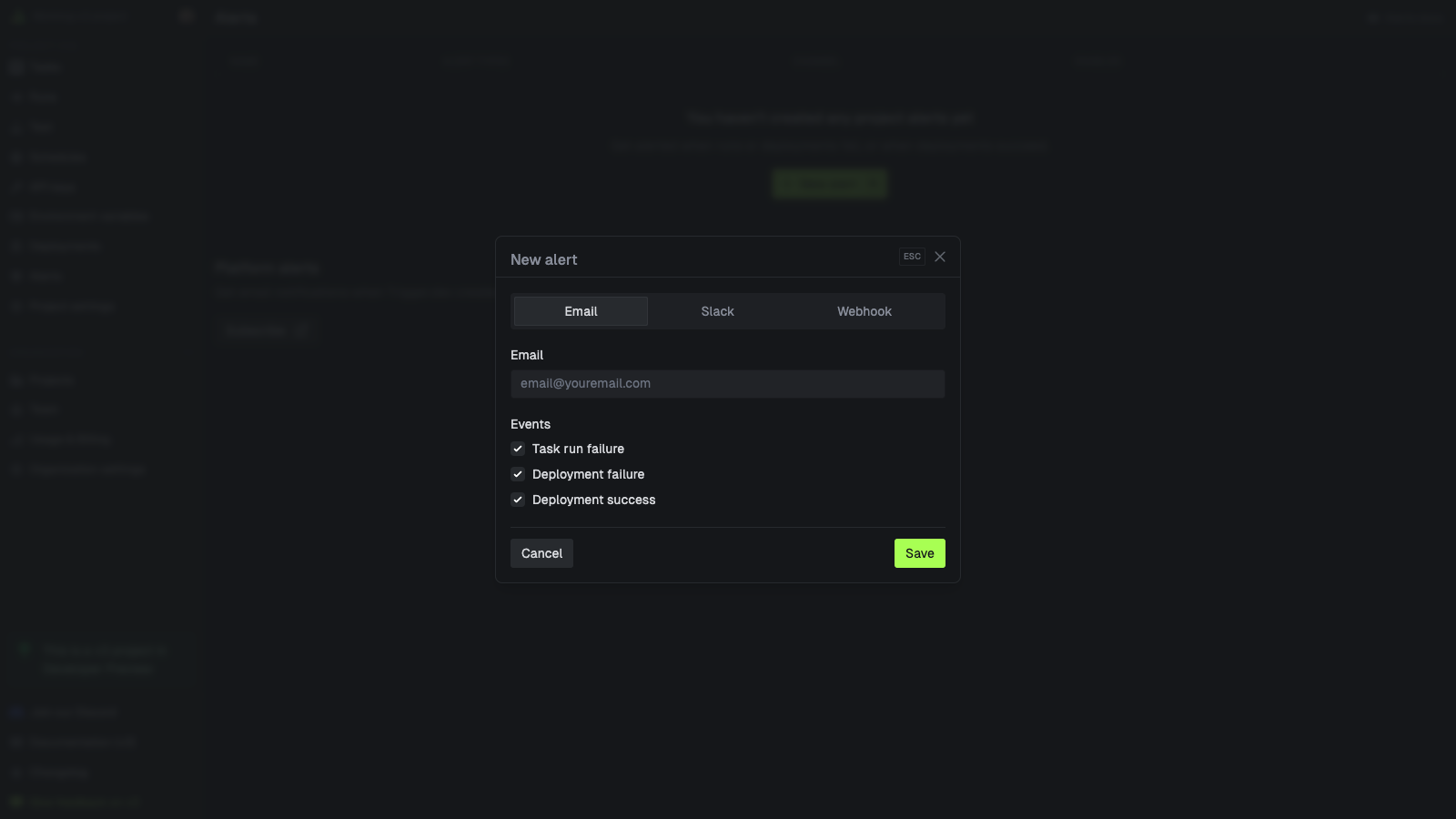
Choose your alert method
Choose to be notified by email, Slack notification or webhook whenever:
- a run fails
- a deployment fails
-
a deployment succeeds
3
Delete or disable alerts
Click on the triple dot menu on the right side of the table row and select “Disable” or “Delete”.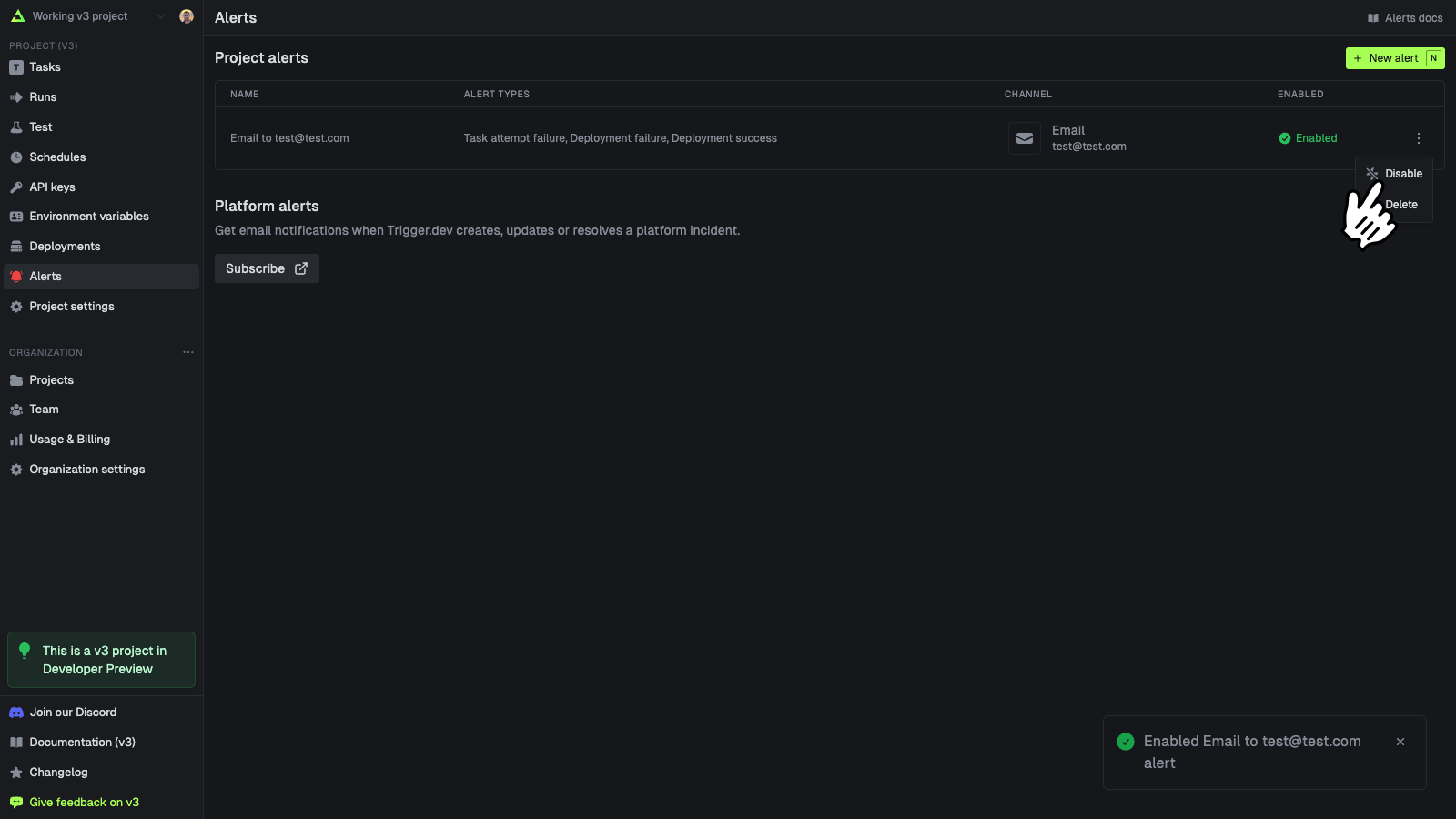
Error group alerts
Error group alerts are issue-based, not run-based. They are created from the Errors page in the dashboard (the “Configure alerts…” button), not from the New alert modal on the Alerts page. Once created they show up in the Alerts table alongside your other alerts, labelled “Error group”. An error group is one distinct error — the same error from many runs is a single group, with a status of Unresolved, Resolved or Ignored that you set from the Errors page.When an error group alert fires
The alert only fires when a group’s status changes in one of these three ways:Why it goes quiet
This is the part that surprises people, so it is worth stating plainly: An Unresolved error group does not alert. After an error group alert fires, the group is set to Unresolved, and it stays silent no matter how many more times that error occurs. It will only alert again once you mark it Resolved (and it then recurs) or Ignored (and the ignore condition is breached). This is intentional — one persistently broken task should not flood your Slack channel with a message per failed run. But it means an Error group alert is not a substitute for a run failure alert. If a task has been failing in production for days and you have had no notification, check whether the only alert you have configured is an Error group alert whose group is sitting at Unresolved.Which alert type should I use?
- “Tell me about every run that fails” → a run fails alert, from the Alerts page. It fires for every run that fails once its retries are exhausted.
- “Tell me when something new breaks” → an Error group alert, from the Errors page.
Alert webhooks
For the alert webhooks you can use the SDK to parse them. Here is an example of how to parse the webhook payload in Remix:Common properties
When you create a webhook alert, you’ll receive different payloads depending on the type of alert. All webhooks share some common properties:string
A unique identifier for this webhook event
datetime
When this webhook event was created
string
The version of the webhook payload format
string
The type of alert webhook. One of:
alert.run.failed, alert.deployment.success, alert.deployment.failed, or alert.errorRun Failed Alert
This webhook is sent when a run fails. The payload is available on theobject property:
string
Unique identifier for the task
string
File path where the task is defined
string
Name of the exported task function
string
Version of the task
string
Version of the SDK used
string
Version of the CLI used
string
Unique identifier for the run
number
Run number
string
Current status of the run
datetime
When the run was created
datetime
When the run started executing
datetime
When the run finished executing
boolean
Whether this is a test run
string
Idempotency key for the run
string[]
Associated tags
object
Error information
boolean
Whether the run was an out-of-memory error
string
Machine preset used for the run
string
URL to view the run in the dashboard
string
Environment ID
string
Environment type (STAGING or PRODUCTION)
string
Environment slug
string
Organization ID
string
Organization slug
string
Organization name
string
Project ID
string
Project reference
string
Project slug
string
Project name
Deployment Success Alert
This webhook is sent when a deployment succeeds. The payload is available on theobject property:
string
Deployment ID
string
Deployment status
string
Deployment version
string
Short code identifier
datetime
When the deployment completed
array
Array of deployed tasks with properties: id, filePath, exportName, and triggerSource
string
Environment ID
string
Environment type (STAGING or PRODUCTION)
string
Environment slug
string
Organization ID
string
Organization slug
string
Organization name
string
Project ID
string
Project reference
string
Project slug
string
Project name
Deployment Failed Alert
This webhook is sent when a deployment fails. The payload is available on theobject property:
string
Deployment ID
string
Deployment status
string
Deployment version
string
Short code identifier
datetime
When the deployment failed
string
Error name
string
Error message
string
Error stack trace (optional)
string
Standard error output (optional)
string
Environment ID
string
Environment type (STAGING or PRODUCTION)
string
Environment slug
string
Organization ID
string
Organization slug
string
Organization name
string
Project ID
string
Project reference
string
Project slug
string
Project name
Error Group Alert
This webhook is sent for an error group alert. The payload is available on theobject property:
string
Why the alert fired. One of:
new_issue, regression, unignoredstring
Identifier for the error group
string
Error type
string
Error message
string
Sample stack trace, if available
string
When the error was first seen
string
When the error was last seen
number
Number of occurrences
string
Task the error occurred in
string
Environment ID
string
Environment name
string
Organization ID
string
Organization slug
string
Organization name
string
Project ID
string
Project reference
string
Project slug
string
Project name
string
URL to view the error in the dashboard